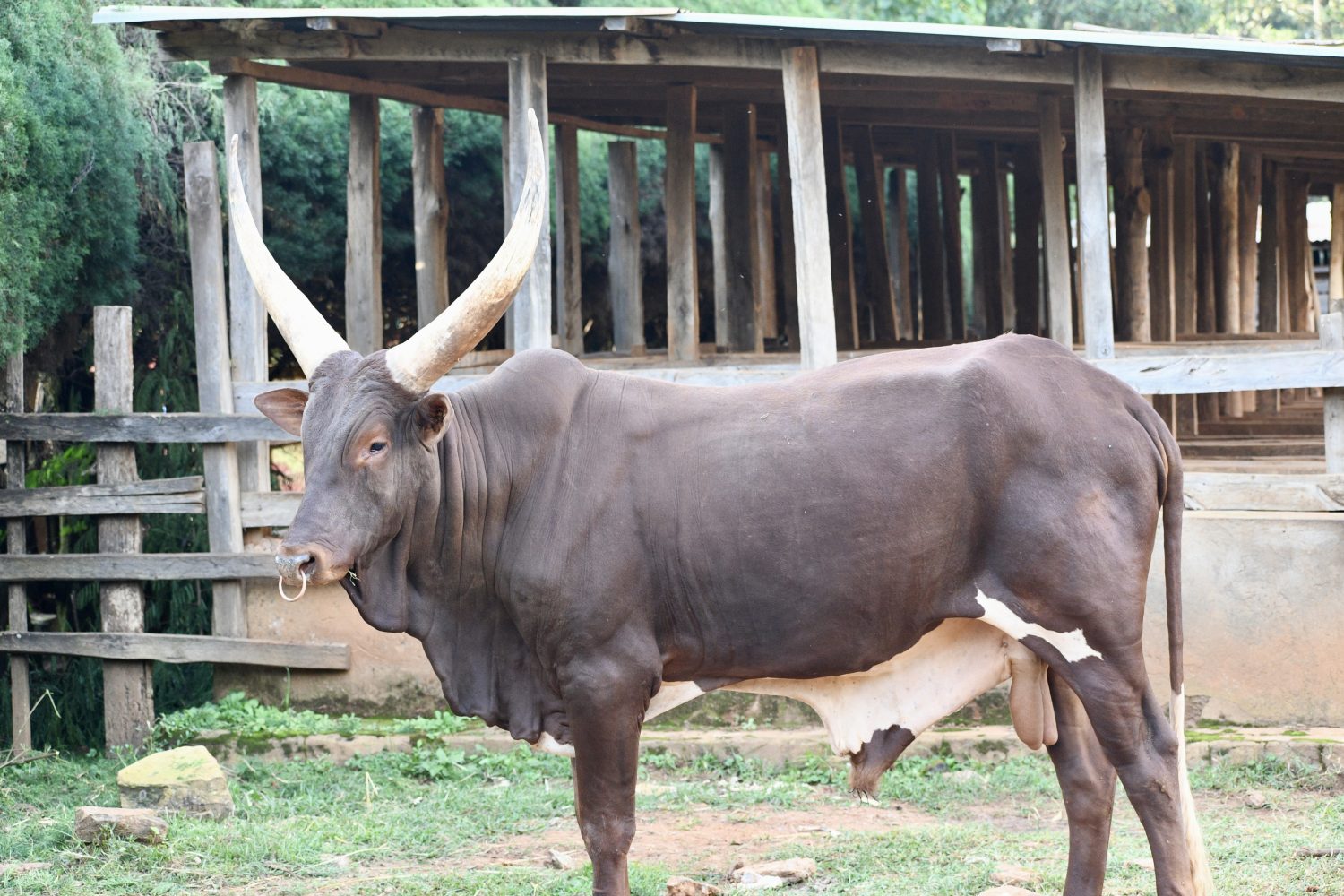
BORAN:
The Boran is medium in size with a short head, small ears, loose dewlap and a large hump above the shoulders. They can be horned or polled. They vary in height from 114cm to 147cm tall, and in weight bulls weigh approximately 500kg to 850kg. Cows weigh about 380kg to 450kg Their skin is loose, thick and extremely pliable for added insect repellency plus it is dark pigmented with fine short hair for heat tolerance. Hair colour can be a range of colours except brindle or solid black.
The Boran male and female share breed points, the sexes, however, show marked dimorphism – the female being notably small, whilst the male grows to a large size. The cow has a well-carried udder with strong attachments and neat, small teats, in contrast to some Asian Zebu breeds. Boran heifers reach puberty at an average age of 385 days. She is an excellent mother, not only will she feed her calf so well that high weaning weights are attainable, but she guards against predators, and will never allow her calf to get lost in the bush. Calving problems hardly exist. Calves at birth weigh an average of 28 kg for males and females, 25 kg.
Boran cattle have developed adaptive traits of crucial importance for their survival. Some of these characters are – the ability to withstand periodic shortage of water and feed, ability to walk long distances in search of water and feed and ability to digest low quality feeds. The herd instinct of the Boran makes it easy to manage and survive in bush country. They will always stay together and can ‘graze on the trot’.
The well-developed beef conformation shows up in carcass appraisals. The depth of eye muscle, marbling, even fat cover and ratio of hind to forequarter make the Boran difficult to beat, hence the preference of Kenya butchers for young, well-finished Boran steers.
References: http://www.thecattlesite.com/breeds/beef/94/boran/
RED POLL
The Red Poll is a dual‑purpose breed developed in eastern England in the early 1800s. Red Poll cattle resulted from the combination of the Norfolk and Suffolk cattle breeds. The Norfolk was a small, hardy, red and white horned breed known for the high quality of its beef. The Suffolk was a red, yellow, or brindle polled dairy breed. The resulting breed was recognized in 1846. Its original name “Norfolk and Suffolk Red Polled cattle” was shortened to Red Poll in about 1880. Breeders selected their cattle for beef and dairy qualities, creating a population that was consistent in appearance, dark red in color, and always polled. Its long history of pure breeding has given the breed exceptional genetic consistency. Bulls are pre-potent, and their offspring are highly predictable and uniform. Distantly related to most other beef breeds, the Red Poll can impart significant hybrid vigor when crossed. Red Poll cattle are medium in size, with cows averaging 1,200 pounds and bulls 1,800 pounds. The cattle are solid red, with a little white on the underline tolerated but not desired. They are adaptable and long-lived. Red Polls have quiet dispositions and they are an excellent choice for rotational grazing and other systems where ease of handling is required. Cows can also be used for small-scale and home dairy production. The milk is high in protein and butterfat, making it especially good for cheese. In England, Red Poll cheese is still produced.
References: https://livestockconservancy.org/
BORAN AND RED POLL CROSS
Though not many, JS-Malomonye ranch has a few dual-purpose cross-bred cattle, mainly Boran-Red Poll breeds, Friesian-Boran and Red Poll-Friesian. Crossbreeding cattle offers two primary advantages relative to the use of only one breed: 1) crossbred animals exhibit (hybrid vigour), and 2) crossbred animals combine the strengths of the various breeds used to form the cross. The goal of a well-designed, systematic crossbreeding program is to simultaneously optimize these advantages of hybrid vigour and breed complementarity.
ANKOLE
Our most recent addition to the ranch, Ankole cattle traditionally considered the cattle of kings and royalty are typically found in Southwest Uganda and in Rwanda having descended from the Ethiopian Sanga Cattle. Ankoles are a hardy breed of cattle living on meager pasture and not requiring much water. What sets them even further apart is the size of horns that can exceed 2.5 meters in length. They are considered dual purpose but cannot produce like typical beef or milk cattle. At JS-Malomonye ranch we are ranching Ankoles alongside the Boran and Red Poll mainly because we have always been fascinated by them. A passion project we are eager to slowly grow our own herd of Ankoles in Western Kenya.
 JS-Malomonye Ranch